Showing posts with label Expedition 47. Show all posts

Saturday, June 18, 2016

Space Station Trio Return to Earth

After a journey spanning almost 79 million miles, the crew of the Soyuz TMA-19M spacecraft have safely returned to Earth after completing their 186 day-long mission to the International Space Station.

Soyuz commander and veteran cosmonaut Yuri Malenchenko alongside crew mates Tim Peake and Tim Kopra landed their vehicle in the remote steppe of Kazakhstan at 9:15 a.m. UTC -  just three hours after leaving their home for the past six months.
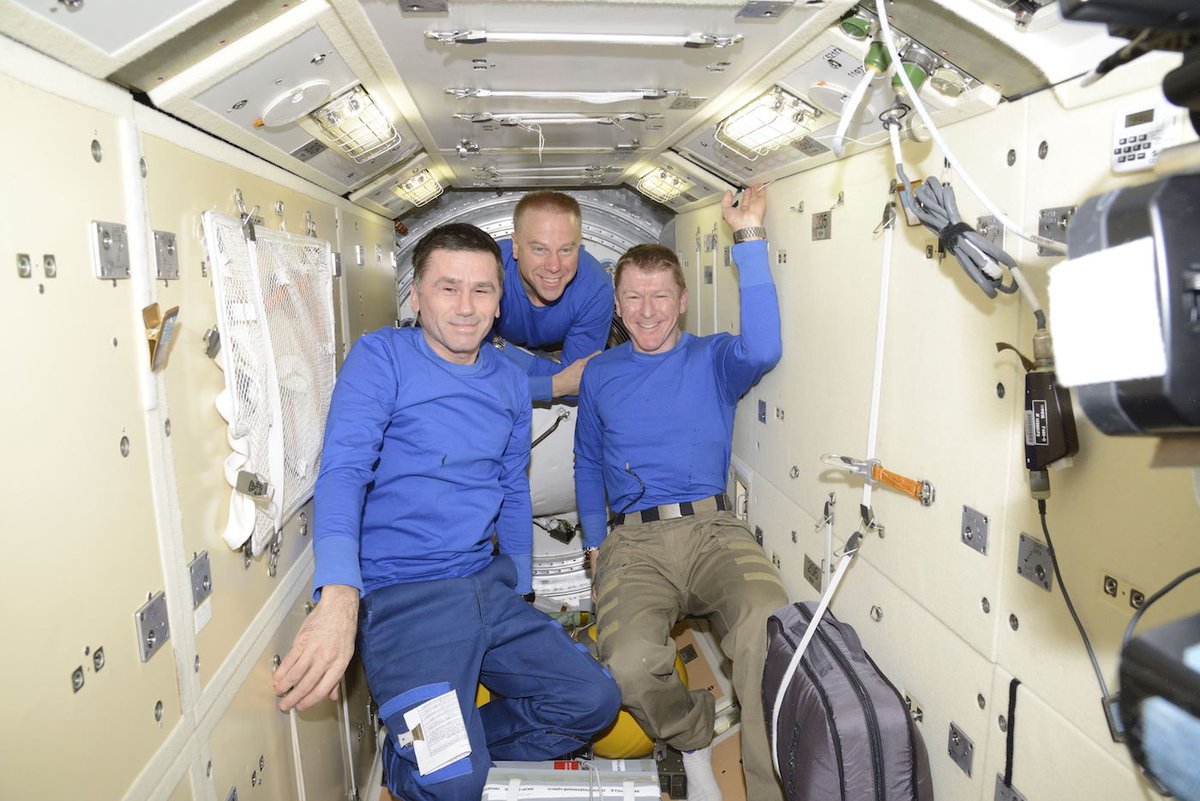
Malenchenko, Kopra and Peake shortly before closing the hatches
between their Soyuz and the International Space Station.
 credit: Roscosmos

The trio bid farewell to their Expedition 47 crew mates early this morning before hatches between the station and the Soyuz were closed. This was followed at 6:52 a.m. by the undocking of the spacecraft from the station's Rassvet module - marking the official beginning of Expedition 48.

Since their arrival to station the crew have conducted hundreds of scientific experiments across a wide range of scientific fields including physics, Earth observation and human physiology experiments. The crew also saw off One Year Crew members Scott Kelly and Mikhail Kornienko back in March.

Having landed under cloudy conditions amid high winds, the crew were extracted one by one from the vehicle by Russian search and recovery forces at the landing site and flown to the remote town of Karaganda a short time later for a welcoming ceremony.

Malenchenko will board a Gagarin Cosmonaut Training Center plane for a flight back to Star City to be reunited with his family, while Peake will return to the European Astronaut Center in Cologne and Kopra will return to the Johnson Space Center in Houston.

This morning's landing concludes the fifth long duration space flight, and the fourth aboard the International Space Station for Malenchenko, who has now logged a total of 828 days in space. European Space Agency astronaut Tim Peake - the first British astronaut to visit the space station Peake logs 186 days in space while and NASA astronaut Kopra now has a total of 244 days of spaceflight across two missions.

In the meantime, station commander Jeff Williams along with Russian flight engineers Alexei Ovchinin and Oleg Skripochka will remain aboard the station until September. Before his departure this morning, Expedition 47 commander Kopra handed over the reigns of the International Space Station to Williams in the traditional Change of Command ceremony in which he paid tribute to the space station programme;
Peake, Malenchenko and Kopra shortly after landing in the remote
steppe of Kazakhstan after 186 days aboard the ISS.
credit: NASA

"We've been so privileged to work here on board with a huge variety of science experiments that we know are going to be a stepping stone for human exploration.. together we've demonstrated that we have a world-class orbiting laboratory."

They will occupy the complex for the next three weeks before being joined in July by the crew of the Soyuz MS-01 comprising of Russian cosmonaut Anatoly Ivanishin, NASA astronaut Kate Rubins and Takuya Onishi of the Japan Aerospace Exploration Agency. The trio are set to launch aboard a Soyuz rocket from the Baikonur Cosmodrome on July 6th.

Thank you for reading Irish Space Blog!

Be sure to follow us on Twitter @irishspaceblog

Friday, April 8, 2016

SpaceX Dragon Returns to Flight Bound for the International Space Station

The SpaceX Dragon capsule has successfully launched from Space Launch Complex 40 at the Cape Canaveral Air Force Station on a mission to deliver science to the International Space Station.

The Commercial Resupply Services(CRS)-8 launched atop a Falcon 9 rocket at 9:43 p.m. Eastern Time under clear skies carrying science research, crew supplies and hardware to the orbiting laboratory in support of the Expedition 47 and 48 crews.
Dragon on its eight flight to the International Space Station launches
atop a Falcon 9 rocket at 10:43 p.m. from Cape Canveral in Florida.
credit: SpaceX

Just minutes after first stage separation, the rocket's first stage fell back to Earth, fired its thrusters and deployed its landing legs before successfully landing upright for the first time on a barge at sea. Today marks the second time that Elon Musk's company has accomplished such a feat - the first coming back on December 21.

The vehicle will arrive at the space station on Sunday April 10 loaded with 6,900 pounds/3,130 kilograms of science and payload to further advance the research capabilities of the International Space Station. From the Cupola, ESA astronaut Tim Peake will capture Dragon with the station's robotic arm, Canadarm-2, before flight controllers in Mission Control in Houston berth Dragon to the Earth-facing port of the station's Harmony module a few hours later.

Today's launch marks the Return to Flight of Dragon having been lost shortly after liftoff on its seventh mission to resupply the complex in June 2015.

Sunday's arrival will be an historic one, as it marks the first time that two commercially-built cargo vehicles will be docked to the International Space Station simultaneously. Orbital ATK's Cygnus cargo craft is currently berthed to the Unity module of the ISS.

On April 15, robotic operators will once again take control of Canadarm-2 and remove the much anticipated Bigelow Expandable Activity Module(BEAM), and berth it to the aft port of the station's Tranquility module.


Bigelow Expandable Activity Module(BEAM)

BEAM is an expandable habitat built by Bigelow Aerospace that will remain on station for a period of two years. NASA and its partners are currently investigating the practicalities of using expandable habitats in the near-Earth environment as well as on future missions to the Moon or Mars.

This will be the first time an expandable habitat will be docked to the station, so the procedure will take some time, allowing teams to closely observe the expansion process as well as the safety of the crew and the station. During this time the module will expand from its packed dimensions of 7.75 feet in diameter and 5.7 feet long, to its pressurised size of 10,5 feet in diameter and 12 feet long.
The Bigelow Expandable Activity Module(BEAM) being loaded into the
trunk of the SpaceX Dragon capsule at Cape Canaveral. credit: NASA

The expandable module is made up of soft fabrics instead of metal which allows the habitat to be packed to a small volume during launch and later expanded to its full size in space. Two radiation sensors, temperature and micrometeorite impacts inside BEAM will help scientists and engineers to better understand thermal, radiation and long-term leak performance of expandable habitats.

The habitat will be inflated by the crew at the end of May and it is expected that crew members will enter BEAM twice or three times per six month increment to swap out sensors that need to be returned to Earth for analysis.

The arrival of Dragon on Sunday will bring to an end the recent period of busy traffic to and from the International Space Station. CRS-8 will be the fourth visiting vehicle to visit the laboratory in as many weeks, following the arrival of the Soyuz TMA-20M, Cygnus CRS OA-6 and the Progress 63P.

Thank you for reading Irish Space Blog!