Showing posts with label Soyuz. Show all posts

Monday, April 10, 2017

Space Station Trio Return to Earth After 73 Million Mile Journey

After a journey of over 73 million miles, the Expedition 49/50 crew have safely returned to Earth after completing a 173 day mission to the International Space Station.

Soyuz commander Sergey Ryzhikov with crew mates Andrey Borisenko and Shane Kimbrough landed their vehicle in the remote steppe of Kazakhstan, southeast of the remote town of Dzhezkazgan at 11:21 p.m. GMT.
Kimbrough, Ryzhikov and Borisenko adjust to life back on Earth shortly
after landing. credit: NASA/Ingalls

The trio bid farewell to their crew mates early this morning before hatches between the station and the Soyuz were closed. This was followed at 7:56 a.m. by the undocking of the spacecraft from the station's Poisk module - marking the official beginning of Expedition 51.

Since their arrival to station the crew have conducted hundreds of scientific experiments across a wide range of scientific fields including biology, biotechnology, physics, Earth observation and human physiology experiments.

Landing in perfect conditions under clear skies, the crew were extracted one by one from the vehicle by Russian search and recovery forces at the landing site and flown to the remote town of Karaganda a short time later for a welcoming ceremony.

Ryzhikov and Borisenko will board a Gagarin Cosmonaut Training Center plane for a flight back to Star City to be reunited with their families, while Kimbrough will return to the Johnson Space Center in Houston.

This morning's landing brings to an end the first long duration space flight for Ryzhikov, and the second for his Russian crew mate Borisenko, who first flew to the station as a Flight Engineer on Expedition 27/28. He now logs a total of 337 days in space.

NASA astronaut Shane Kimbrough, who previously flew on a short-duration mission to the station on space shuttle mission STS-126, returns to Earth with a combined 184 days in space under his belt.

Before his departure this morning, Kimbrough handed over the reigns of the International Space Station to Whitson in the traditional Change of Command ceremony, in which he recognised the difference science conducted in space has for people the world over;

"We get the ability to interact with things up here that benefit all humanity."
The Soyuz MS-02 carrying Ryzhikov, Borisenko and Kimbrough shortly before landing at 11:21 a.m. GMT.
Credit: NASA/Ingalls
In the meantime, station commander Peggy Whitson alongside Russian cosmonaut Oleg Novitskiy and European Space Agency astronaut Thomas Pesquet remain aboard station. Whitson, who became the first two-time female commander of the International Space Station with this morning's departure paid tribute to her commander for the past four and a half months.

"Up here we don't wear shoes but Shane's leaving me some big socks to fill!"

Meanwhile back on Earth, veteran Russian cosmonaut Fyodor Yurchikhin and NASA astronaut Jack Fischer are in the final stages preparations for their launch to the International Space Station. The duo will launch in their Soyuz MS-04 spacecraft from the Baikonur Cosmodrome on April 20.

Thank you for reading Irish Space Blog!

Be sure to follow us on Twitter @irishspaceblog

Saturday, June 18, 2016

Space Station Trio Return to Earth

After a journey spanning almost 79 million miles, the crew of the Soyuz TMA-19M spacecraft have safely returned to Earth after completing their 186 day-long mission to the International Space Station.

Soyuz commander and veteran cosmonaut Yuri Malenchenko alongside crew mates Tim Peake and Tim Kopra landed their vehicle in the remote steppe of Kazakhstan at 9:15 a.m. UTC -  just three hours after leaving their home for the past six months.
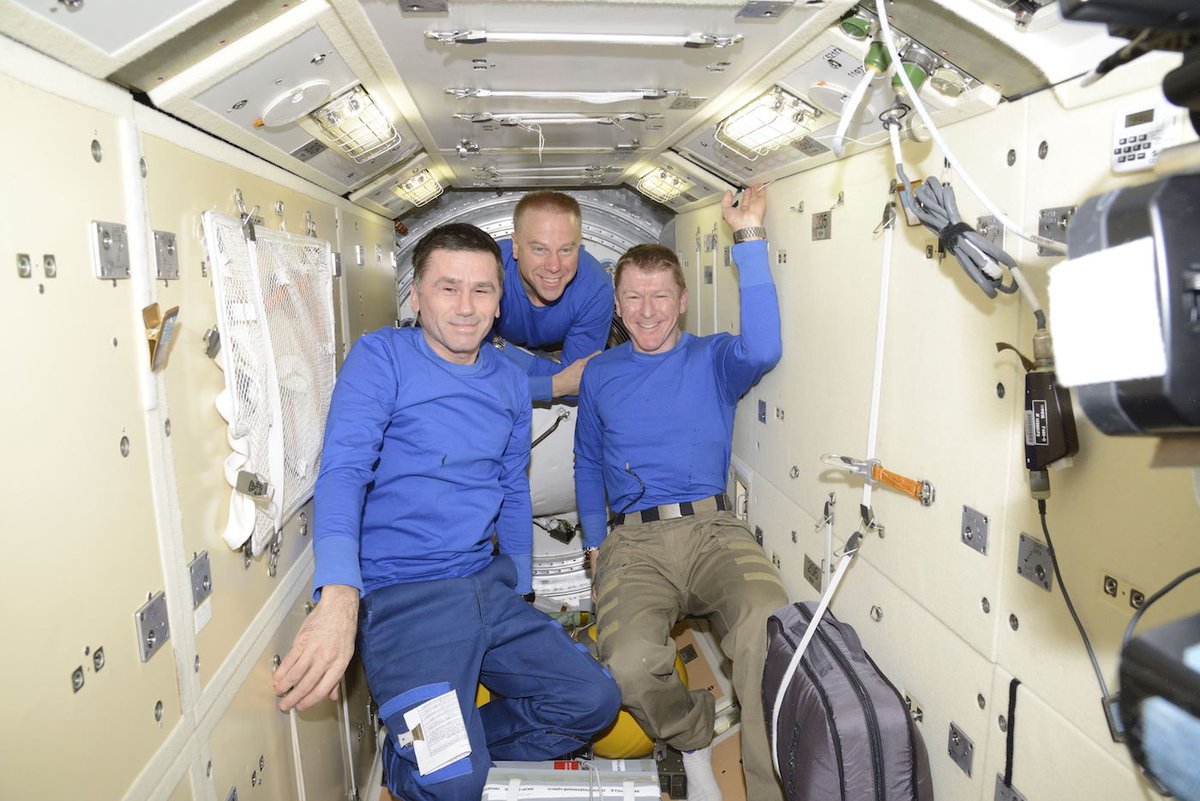
Malenchenko, Kopra and Peake shortly before closing the hatches
between their Soyuz and the International Space Station.
 credit: Roscosmos

The trio bid farewell to their Expedition 47 crew mates early this morning before hatches between the station and the Soyuz were closed. This was followed at 6:52 a.m. by the undocking of the spacecraft from the station's Rassvet module - marking the official beginning of Expedition 48.

Since their arrival to station the crew have conducted hundreds of scientific experiments across a wide range of scientific fields including physics, Earth observation and human physiology experiments. The crew also saw off One Year Crew members Scott Kelly and Mikhail Kornienko back in March.

Having landed under cloudy conditions amid high winds, the crew were extracted one by one from the vehicle by Russian search and recovery forces at the landing site and flown to the remote town of Karaganda a short time later for a welcoming ceremony.

Malenchenko will board a Gagarin Cosmonaut Training Center plane for a flight back to Star City to be reunited with his family, while Peake will return to the European Astronaut Center in Cologne and Kopra will return to the Johnson Space Center in Houston.

This morning's landing concludes the fifth long duration space flight, and the fourth aboard the International Space Station for Malenchenko, who has now logged a total of 828 days in space. European Space Agency astronaut Tim Peake - the first British astronaut to visit the space station Peake logs 186 days in space while and NASA astronaut Kopra now has a total of 244 days of spaceflight across two missions.

In the meantime, station commander Jeff Williams along with Russian flight engineers Alexei Ovchinin and Oleg Skripochka will remain aboard the station until September. Before his departure this morning, Expedition 47 commander Kopra handed over the reigns of the International Space Station to Williams in the traditional Change of Command ceremony in which he paid tribute to the space station programme;
Peake, Malenchenko and Kopra shortly after landing in the remote
steppe of Kazakhstan after 186 days aboard the ISS.
credit: NASA

"We've been so privileged to work here on board with a huge variety of science experiments that we know are going to be a stepping stone for human exploration.. together we've demonstrated that we have a world-class orbiting laboratory."

They will occupy the complex for the next three weeks before being joined in July by the crew of the Soyuz MS-01 comprising of Russian cosmonaut Anatoly Ivanishin, NASA astronaut Kate Rubins and Takuya Onishi of the Japan Aerospace Exploration Agency. The trio are set to launch aboard a Soyuz rocket from the Baikonur Cosmodrome on July 6th.

Thank you for reading Irish Space Blog!

Be sure to follow us on Twitter @irishspaceblog

Friday, April 8, 2016

SpaceX Dragon Returns to Flight Bound for the International Space Station

The SpaceX Dragon capsule has successfully launched from Space Launch Complex 40 at the Cape Canaveral Air Force Station on a mission to deliver science to the International Space Station.

The Commercial Resupply Services(CRS)-8 launched atop a Falcon 9 rocket at 9:43 p.m. Eastern Time under clear skies carrying science research, crew supplies and hardware to the orbiting laboratory in support of the Expedition 47 and 48 crews.
Dragon on its eight flight to the International Space Station launches
atop a Falcon 9 rocket at 10:43 p.m. from Cape Canveral in Florida.
credit: SpaceX

Just minutes after first stage separation, the rocket's first stage fell back to Earth, fired its thrusters and deployed its landing legs before successfully landing upright for the first time on a barge at sea. Today marks the second time that Elon Musk's company has accomplished such a feat - the first coming back on December 21.

The vehicle will arrive at the space station on Sunday April 10 loaded with 6,900 pounds/3,130 kilograms of science and payload to further advance the research capabilities of the International Space Station. From the Cupola, ESA astronaut Tim Peake will capture Dragon with the station's robotic arm, Canadarm-2, before flight controllers in Mission Control in Houston berth Dragon to the Earth-facing port of the station's Harmony module a few hours later.

Today's launch marks the Return to Flight of Dragon having been lost shortly after liftoff on its seventh mission to resupply the complex in June 2015.

Sunday's arrival will be an historic one, as it marks the first time that two commercially-built cargo vehicles will be docked to the International Space Station simultaneously. Orbital ATK's Cygnus cargo craft is currently berthed to the Unity module of the ISS.

On April 15, robotic operators will once again take control of Canadarm-2 and remove the much anticipated Bigelow Expandable Activity Module(BEAM), and berth it to the aft port of the station's Tranquility module.


Bigelow Expandable Activity Module(BEAM)

BEAM is an expandable habitat built by Bigelow Aerospace that will remain on station for a period of two years. NASA and its partners are currently investigating the practicalities of using expandable habitats in the near-Earth environment as well as on future missions to the Moon or Mars.

This will be the first time an expandable habitat will be docked to the station, so the procedure will take some time, allowing teams to closely observe the expansion process as well as the safety of the crew and the station. During this time the module will expand from its packed dimensions of 7.75 feet in diameter and 5.7 feet long, to its pressurised size of 10,5 feet in diameter and 12 feet long.
The Bigelow Expandable Activity Module(BEAM) being loaded into the
trunk of the SpaceX Dragon capsule at Cape Canaveral. credit: NASA

The expandable module is made up of soft fabrics instead of metal which allows the habitat to be packed to a small volume during launch and later expanded to its full size in space. Two radiation sensors, temperature and micrometeorite impacts inside BEAM will help scientists and engineers to better understand thermal, radiation and long-term leak performance of expandable habitats.

The habitat will be inflated by the crew at the end of May and it is expected that crew members will enter BEAM twice or three times per six month increment to swap out sensors that need to be returned to Earth for analysis.

The arrival of Dragon on Sunday will bring to an end the recent period of busy traffic to and from the International Space Station. CRS-8 will be the fourth visiting vehicle to visit the laboratory in as many weeks, following the arrival of the Soyuz TMA-20M, Cygnus CRS OA-6 and the Progress 63P.

Thank you for reading Irish Space Blog!

Wednesday, March 2, 2016

One Year Crew Returns from International Space Station

Astronaut Scott Kelly and cosmonaut Mikhail Kornienko have returned to Earth after spending almost one year living and working in low-Earth orbit aboard the International Space Station.

The One Year crew alongside their Soyuz commander Sergey Volkov bid farewell to the International Space Station as the hatches between the station and the Soyuz TMA-18M spacecraft were closed at 9:43 p.m. GMT on March 1.
Year in Space crew members Kelly and Kornienko shortly after landing in Kazakhstan
after spending 340 days aboard the International Space Station.
credit: NASA/Bill Ingalls

The Soyuz craft departed the complex a couple of hours later when it undocked from the space station's Poisk module at 1:02 a.m. on the morning of March 2.

Following a series of orbital maneuvers, the Soyuz performed its de-orbit burn to reduce the spacecraft's speed and altitude for a fiery re-entry through the Earth's atmosphere.

Just over three hours after departing the ISS, Volkov, Kelly and Kornienko landed their vehicle in the remote steppe of Kazakhstan at 4:26 a.m. - bringing the Year in Space mission to an end. The crew were then placed in reclining chairs next to their Soyuz before being carried a short distance to an awaiting medical tent to get the crew out of their Sokol launch and entry suits to participate in brief field tests.

These field test studies are conducted to see the effect that long term weightlessness has on the astronaut's ability to stand from a seated position, walk through obstacles and stand upright. This will help investigators further understand what future space farers will be able to do once they've landed on Mars having spent months in a weightless commute.

In a recent interview with NASA TV, Kelly was asked what he thought was the biggest accomplishment of this flight - "We absolutely accomplished an incredible amount of work both on the US Operational Segment and on the Russian Segment."

"Our time here has demonstrated not only the capability for us to stay in space for a long time and to do well, but also the capability of ground teams to support us, the sytsems that keep us alive and the resuspply in a way that is forward thinking towards a potential flight to Mars. We've collected a lot of data during our time here and that data is something that's going to be analysed later.. but I think it's been a great success and a real privilege to part of it."

Over the past 340 days, Kelly and Kornienko:

  • Completed 5,440 orbits of the Earth.
  • Ran over 640 miles on the station's treadmill.
  • Travelled 143,846,525 miles - roughly the distance from Earth to Mars. A return journey to the red planet is expected to last 500 days or longer.
  • Conducted over 400 scientific experiments during the course of their stint aboard the complex.


Coming Home: Kelly, Volkov and Kornienko tightly packed inside their Soyuz
credit: NASA
"Misha and I are only one data point. You need a lot more numbers to draw specific conclusions but I'm hoping what we find is a lot of information that will help us eventually continue on our path toward Mars."

Another unique investigation conducted over the past year is the Twins Study. Former NASA astronaut Mark Kelly, Scott Kelly's identical twin has served as the control subject for his brother on orbit. This study hopes to investigate if the effect of long-duration spaceflight has any difference on the body on a genetic level.

Today's landing brings to an end the fourth spaceflight for Scott Kelly who has now logged 520 days in space and sets the record for the most time in space for an American. Mikhail Kornienko now logs 516 across two space station expeditions. Soyuz commander Sergey Volkov returns to Earth with 548 days in space across three long-duration stays aboard the International Space Station.

The departure of the Soyuz marked the official beginning of Expedition 47 after Kelly handed over the reigns of the orbiting laboratory to Tim Kopra of NASA. Kopra remains aboard the station with cosmonaut Yuri Malenchenko and ESA astronaut Tim Peake.

The trio will be joined on March 19 when the Soyuz TMA-20M docks to the vacant docking port on Poisk - bringing Alexei Ovchinin, Oleg Skripochka and Jeff Williams to the station for a six month mission.

Thank you for reading Irish Space Blog!

Be sure to follow us on Twitter and Google+


Friday, February 19, 2016

Cygnus Cargo Craft Departs International Space Station

Orbital ATK's Cygnus cargo ship has departed the International Space Station after a successful 72 day mission to resupply the orbiting laboratory.

Having been unberthed from the Unity Module of the complex earlier in the day, Expedition 46 Commander Scott Kelly and Flight Engineer Tim Kopra used the station's 57-foot robotic arm to release the unmanned Cygnus at 12:26 p.m. GMT as the two vehicles flew 400 kilometers over Bolivia. This positioned Cygnus for a fiery re-entry into the Earth's atmosphere over the Pacific Ocean on Saturday.
Cygnus departs the International Space Station(File photo)
credit: NASA
On its fourth mission to resupply the space station, the vehicle nicknamed "S.S. Deke Slayton II" launched atop an Atlas V rocket carrying over 3,500 kilograms of cargo from Space Launch Complex 41 at Cape Canaveral in Florida on December 6.

Among the cargo which served the Expedition 45/46 crews was a new life sciences facility and a micro-satellite deployer, as well as food and other crew provisions.

Today's departure of Deke Slayton II also marks the beginning of a busy period of traffic from visiting vehicles to and from the station. 

On March 1 the year-long mission to the ISS conducted by Scott Kelly and Russian cosmonaut Mikhail Kornienko will come to an end as the pair undock their Soyuz TMA-18M from the Poisk module on the Russian segment of the International Space Station alongside Sergey Volkov.
Kelly and Kornienko have been living aboard the station since their arrival on March 28 2015. By the time they return to Earth they will have spent 340 days in space and traveled over 140 million miles.

The departure of Kelly, Kornienko and Volkov will clear the way for the arrival of the next Soyuz to bring three new crew members to the International Space Station. Cosmonauts Oleg Skripochka, Alexey Ovchinin and astronaut Jeff Williams will dock their Soyuz TMA-20M to the vacant docking port on Poisk on March 19. This will be followed just three days later by the launch of the next Cygnus vehicle on it's fifth flight to the station.

Thank you for reading Irish Space Blog!


Friday, December 11, 2015

Space Station Trio Return to Earth

The crew of the Soyuz TMA-17M spacecraft have returned to Earth after completing their 141 day-long mission to the International Space Station.

Soyuz commander Oleg Kononenko alongside crew mates Kjell Lindgren and Kimiya Yui landed their vehicle in the remote steppe of Kazakhstan at around 1:12 p.m. GMT.

Kononenko, Lindgren and Yui bid farewell to their Expedition 45 crew mates early this morning before hatches between the station and the Soyuz were closed. This was followed at 9:49 a.m. by the undocking of the spacecraft, marking the official beginning of Expedition 46.

Lindgren tweeted: "All loaded up! Farewell to our Exp 45 crew mates
and the magnificent International Space Station! Hello Earth!"
credit: NASA
Expedition 45 flight engineer Sergey Volkov, who remains aboard the station with One Year Crew members Scott Kelly and Mikhail Kornienko had time to wish the departing crew one final goodbye shortly after undocking"Don't miss us too much- we'll see you in March."

The Soyuz TMA-17M crew have been living aboard the orbiting laboratory since July and have conducted hundreds of scientific experiments across a wide range of scientific fields including physics, Earth observation and human physiology experiments. Three Extra-Vehicular Activities(spacewalks) were also conducted during Expedition 44/45 to maintain the station.

The spacecraft landed in a flurry of snow storms in darkness which marked only the sixth night landing of a Soyuz vehicle returning from the International Space Station, and the first of such landings to take place after sunset. The crew were extracted one by one from the vehicle by Russian search and recovery forces at the landing site and immediately flown to the remote town of Dzhezkazgan for primary medical testing and a welcoming ceremony.

Kononenko will board a Gagarin Cosmonaut Training Center plane for a flight back to Star City to be reunited with his family. Lindgren and Yui will board a NASA plane for a flight back to Houston.

Altogether the crew have traveled 59.6 million miles in space since their launch from the Baikonur Cosmodrome in Kazakhstan on July 22 last.. 

This afternoon's landing concludes the third long duration space flight for Kononenko who has now logged a total of 533 days in space. NASA astronaut Lindgren and JAXA astronaut Yui, both returning from their first space flight, log 141 days in space.

In the meantime, station commander Scott Kelly along with Russian flight engineers Mikhail Kornienko and Sergey Volkov will remain aboard the station until March 2 2016. Kelly and Kornienko have been living aboard the ISS since March of this year and are the first station crew members to participate in a year-long mission living and working aboard the laboratory.

Kelly, Kornienko and Volkov will be alone on the station for just four days before being joined on December 15 by the crew of the Soyuz TMA-19M comprising of veteran cosmonaut Yuri Malenchenko, NASA astronaut Tim Kopra and rookie space flier Tim Peake of the European Space Agency. Th trio are set to launch aboard a Soyuz rocket from the Baikonur Cosmodrome at 11:03 a.m.

Thank you for reading Irish Space Blog!

Be sure to follow us on Twitter @irishspaceblog

Thursday, June 11, 2015

Space Station Trio Return to Earth after Extended Mission

The crew of the Soyuz TMA-15M spacecraft have returned to Earth after completing their 199 day-long mission to the International Space Station.

Virts, Shkaplerov and Cristoforetti in their reclining chairs
shortly after landing credit: NASA
Soyuz commander Anton Shkaplerov and crew mates Terry Virts and Samantha Cristoforetti landed their vehicle in the remote steppe of Kazakhtan at 14:45 UTC. under the setting Kazakh sun.

Shkaplerov, Virts and Cristoforetti said their goodbyes to their Expedition 43 crew mates early this morning before hatches between the station and the Soyuz were closed. This was followed at 11:20 by the undocking of the spacecraft, marking  the beginning of Expedition 44.

Expedition 43 commander Virts handed over the reigns of the station to Russian cosmonaut Gennady Padalka, marking his fourth stint at the commander of the complex.

The Soyuz TMA-15M crew were originally slated to return to Earth last month, but the failure of the Russian Progress 59 resupply ship destined for the complex led to the postponement of their return home.

Shortly after landing in perfect conditions the crew were extracted one by one from the vehicle by Russian search and recovery forces at the landing site. They then sat for a short period in reclining chairs as they got a chance to come to terms with gravity once again after spending six and a half months in the microgravity environment aboard the ISS. The trio were then carried a short distance to an inflatable medical tent for brief testing and were also able to don some more comfortable clothing for a two hour helicopter ride to the staging city of Karaganda in Kazakhstan for a short welcoming ceremony. 

Altogether the crew have travelled 84.2 million miles in space since their launch from the Baikonur Cosmodrome in Kazakhstan last November. 

"I'm going to miss these guys up here. Congrats on your safe return to Earth"
-Scott Kelly on Twitter
This afternoon's landing concludes the second long duration space flight for Shkaplerov who has now logged a total of 364 days in space. Terry Virts who has also just wrapped up his second flight to the station having previously flown there for a 13 day-long space shuttle mission in 2010 now has a total of 212 days of space flight experience under his belt. As for Cristoforetti, fresh from completing her first flight into space having been selected as an astronaut by the European Space Agency in 2009 now holds the record for the longest single space flight by a female, previously held by NASA astronaut Suni Williams.

In the meantime, Commander Padalka and his Expedition 44 crew mates Mikhail Kornienko and Scott Kelły will remain by themselves aboard the station for the next six weeks. They will be joined in late July by Oleg Kononenko, Kjell Lindgren and Kimiya Yui- the crew of the Soyuz TMA-17M.

Thank you for reading Irish Space Blog!

Be sure to follow us on Twitter @irishspaceblog


Wednesday, May 13, 2015

Failed Russian Progress Resupply Ship Burns Up In Atmosphere


The Russian Progress M-27M cargo spacecraft which failed to dock with the International Space Station last month has re-entered the Earth's atmosphere at 02:20 UTC over the Pacific Ocean.
Having launched from the Baikonur Cosmodrome in Kazakhstan on April 28 and loaded with over three tonnes of fuel, food and cargo for the orbiting complex, Russian Mission Control declared that they were experiencing propulsion, telemetry and communications issues with the spacecraft shortly after it separated from the Soyuz rocket.
File photo of a Progress Resupply Ship
credit: NASA TV

Video cameras installed on the vehicle showed that it had entered into an uncontrolled spin of roughly one rotation every four to five seconds. All attempts by Russian ground controllers to regain control of the vehicle were unsuccessful, and the decision was made to cancel the planned docking to the station on Wednesday April 29 when it ecame apparent that rendezvous and docking would not be possible.

The crew aboard the station in the meantime are doing well and have sufficient supplies on board to last for over four months. Expedition 43 Flight Engineer and ISS One Year Crew member Scott Kelly of NASA spoke with the Associated Press recently about the problems with the Progress,
"The important thing is that hardware can be replaced.. and we'll continue to operate the space station."

The next cargo ship on the manifest to visit the station will be a SpaceX Dragon resupply ship. This will be the company's seventh resupply mission to the station, scheduled to launch from Florida on June 19.

In the meantime, the Russian Federal Space Agency(Roscosmos) will be investigating the incident in order to find athe root cause of the anomaly. The Progress M-27M was the 150th Russian space freighter launched into space, and is only the second one to have suffered a casatrophic/major malfunction during its mission to resupply the ISS. In August 2011 a system error with the Soyuz rocket prevented the vehicle from reaching orbit.


Thank you for reading Irish Space Blog!


Monday, March 30, 2015

The Challenges of a One Year Mission to Space

On Friday March 27 2015, astronaut Scott Kelly and cosmonaut Mikhail Kornienko launched atop a Soyuz rocket from the Baikonur Cosmodrome in Kazakhstan, marking the beginning of a year-long mission to the International Space Station.

Kelly and Kornienko, known as the "One Year Crew" launched from the Baikonur Cosmodrome in Kazakhstan along with cosmonaut Gennady Padalka at 19:42 GMT on Friday. The pair will live aboard the orbiting complex for one year, before returning to Earth in March 2016.
Padalka, Kelly and Kornienko prior to launch from Baikonur
credit: NASA

The one year mission will allow scientists to see how the human body will adapt to the microgravity conditions found aboard the ISS, as well as examining the psychological effects of living off the planet for one year.  The scientific community will also be carefully watching how Kelly and Kornienko re-adapt to life back on Earth after spending a year in low-Earth orbit.

Changes in vision are just one of the many side effects that have been observed in some astronauts returning from long-duration spaceflights, and researchers want to learn more about its root causes and develop countermeasures to minimize this risk.

The duo will also have to combat bone and muscle loss (which happens to every astronaut when they fly in space for several months) by exercising for 2.5 hours each day, using the station's treadmills, bike machine known as CEVIS(Cycle Ergometer with Vibration Isolation and Stabilization System) and a weights machine called ARED(Advanced Resistive Exercise Device). For a six month mission, astronauts can lose up to 15% muscle volume.

Just in case you were wondering, this will not be the first time human beings will be sent into orbit for a year-long mission. In 1994, cosmonaut Valeri Polyakov spent 437 days living aboard the Russian space station Mir, before returning to Earth in 1995. Despite suffering from a clear decline in morale for the first two months of his mission, Polyakov was able to regain his pre-flight mood for the rest of his stay aboard the station.

Upon returning to Earth in his Soyuz capsule after a successful mission, Polyakov decided he would rather walk the small distance from his spacecraft to a nearby reclining chair, demonstrating that humans would be able to walk on the surface of Mars after several weightless months in transit from Earth. This extra-long duration mission showed that the human body could deal with the strains and stresses of living in space for such an extended period of time. However, Kelly and Kornienko will be the first space farers to spend a year living on the International Space Station.

ESA astronaut and Expedition 26/27 Flight Engineer Paolo Nespoli, who spent six months living on the ISS in 2010 & 2011, told me that now is a good time to attempt a mission of this nature:

 "I feel we need to know more about what happens to the body and what happens to the mind when you stay in space for a long time, so I think that now is a good time and I think we should do it."

Nespoli went on to mention that the technology we have on the space station is far superior to what Polyakov had at his disposal on Mir, and how it will be easier to connect with family, friends and Mission Control teams all over the world.

Kelly in the station's Cupola during Expedition 26
credit: NASA
"There was a Russian cosmonaut(Polyakov) who stayed in space for well over a year, so the Russians have done this in a more restricted and confined environment than what is today space station, where we have internet, telephone, teleconference capabilities so we can talk to Mission Control whenever we want".

I also asked Doug Wheelock about his thoughts on the upcoming mission, and what challenges would be faced by the one year crew. He went on to say that the biggest obstacles would be dealing with the mental stresses of living off the planet for such a long time:

"I think the greatest challenge will be managing the physiology & psychology of isolation, emotion, & senses... it is critical to stay in the moment".

Finally, I recently spoke with Expedition 35/36 Flight Engineer Chris Cassidy, who returned from the International Space Station back in September 2013, about his thoughts on the one year mission:

"In my experience on coming home day, as we were closing the hatch I thought to myself "What would I think if I was halfway done right now? How would I feel? What would I need? To be honest I felt a little accumulative fatigue- when you're living at your workplace, and you can't shut the door to work and go home in the evening and kick back and watch Monday Night Football- you're there all the time and it eventually catches up to you".

Cassidy, who completed a total of three spacewalks, or EVAs, during his most recent flight, also had a few ideas regarding how the crew doesn't become fatigued with the heavy workload that comes with living aboard the orbiting outpost, suggesting a longer weekend from time to time in the second half of the mission:

"I think my recommendation would be in months 7 through 12, the second half of the year is to have a three day weekend every month because you really need a good recharge. Sunday is a really good day to have a recharge, and to have an extra Sunday thrown in the mix every now and then would go a long way".

The International Space Station
credit: NASA
All in all, it appears that everyone in science and space exploration fields are confident about the one year mission. Both Kelly and Kornienko have lived aboard the ISS before, so it's fair to say that we have a very experienced crew on our hands, logging over 360 days in space between them. In addition, their Soyuz Commander Gennady Padalka will become the first four-time commander of the space station, and upon returning to Earth at the end of Expedition 44 will have logged a total of nearly 900 days in space - the longest time spent in space by any human being.

It is hoped that data recorded from this mission will assist teams on the ground in their understanding of the effects of long terms weightlessness on the body, and what it may be like for humans if they were sent on a mission to Mars in the future. After Kelly and Kornienko return to Earth in 2016, we will no doubt, be one small step closer to the human exploration of the Red Planet.

Godspeed Scott and Misha!

Thank You for reading Irish Space Blog!

Be sure to follow us on Twitter! 

Monday, November 24, 2014

Soyuz Trio Arrive at International Space Station

The Soyuz TMA-15M spacecraft carrying three astronauts and cosmonauts has arrived at the International Space Station, just six hours after launch from Kazakhstan.

The Soyuz rocket carrying Russian cosmonaut Anton Shkaplerov, NASA astronaut Terry Virts and Samantha Cristoforetti of the European Space Agency, lifted off from the Baikonur Cosmodrome in Kazakhstan at 21:01 GMT.

On reaching Earth orbit less than nine minutes after launch, the Soyuz spacecraft deployed it's solar arrays, performed a series of orbital burns and manoeuvres- setting its course for the orbiting complex.

After a four orbit orbital rendezvous, the Soyuz successfully docked with the Rassvet Module of the International Space Station's Russian segment at 02:53.
The Expedition 42 crew aboard the ISS speaking with family.
The hatches between the Soyuz and the station were opened after leak checks were completed, as Shkaplerov, Virts and Cristoforetti were greeted by the Expedition 42 prime crew members already aboard the station, restoring the station's crew complement to six people.

The new station residents who are expected to remain on the ISS for the next five months, before returning to Earth in May 2015. They will begin life aboard their new home by adjusting to microgravity and becoming familiar with their surroundings.

This is the second long duration mission mission to the ISS for Shkaplerov, who spent six months aboard the orbital laboratory as a Flight Engineer during Expedition 29/30. 

This is the first long duration flight for Virts, and his second flight into space, after piloting Space Shuttle Atlantis to the International Space Station on shuttle mission STS-130 back in 2010.

This is the first flight into space for rookie ESA astronaut Samantha Cristoforetti, having been selected as an astronaut by the agency in 2009.


Thank you for reading Irish Space Blog!

Be sure to follow us on Twitter

Friday, January 24, 2014

The Challenges of a One-Year Mission to Space


On Friday March 27 2015, astronaut Scott Kelly and cosmonaut Mikhail Kornienko launched atop a Soyuz rocket from the Baikonur Cosmodrome in Kazakhstan, marking the beginning of a year-long mission to the International Space Station.

Kelly and Kornienko, known as the "One Year Crew" launched from the Baikonur Cosmodrome in Kazakhstan along with cosmonaut Gennady Padalka at 19:42 GMT on Friday. The pair will live aboard the orbiting complex for one year, before returning to Earth in March 2016.
Padalka, Kelly and Kornienko prior to launch from Baikonur
credit: NASA

The one year mission will allow scientists to see how the human body will adapt to the microgravity living and working conditions found aboard the ISS, as well as examining the psychological effects of living off the planet for one year.  The scientific community will also be carefully watching how Kelly and Kornienko re-adapt to life back on Earth after spending a year in low-Earth orbit.

Changes in vision are just one of the many side effects that have been observed in some astronauts returning from long-duration spaceflights, and researchers want to learn more about its root causes and develop countermeasures to minimize this risk.

The duo will also have to combat bone and muscle loss (which happens to every astronaut when they fly in space for several months) by exercising for 2.5 hours each day, using the station's treadmills, bike machine known as CEVIS(Cycle Ergometer with Vibration Isolation and Stabilization System) and a weights machine called ARED(Advanced Resistive Exercise Device). For a six month mission, astronauts can lose up to 15% muscle volume.

Just in case you were wondering, this will not be the first time human beings will be sent into orbit for a year-long mission. In 1994, cosmonaut Valeri Polyakov spent over 437 days living aboard the Russian space station Mir, before returning to Earth in 1995. Despite suffering from a clear decline in morale for the first two months of his mission, Polyakov was able to regain his pre-flight mood for the rest of his stay aboard the station.

Upon returning to Earth in his Soyuz capsule after a successful mission, Polyakov decided he would rather walk the small distance from his spacecraft to a nearby reclining chair, demonstrating that humans would be able to walk on the surface of Mars after several weightless months in transit from Earth. This extra-long duration mission showed that the human body could deal with the strains and stresses of living in space for such an extended period of time. However, Kelly and Kornienko will be the first space farers to spend a year living on the International Space Station.

Recently I began asking astronauts who have spent time living and working aboard the ISS about the one year mission, and what they thought the biggest challenges will be for Kelly and Kornienko.

ESA astronaut and Expedition 26/27 Flight Engineer Paolo Nespoli, who spent six months living on the ISS in 2010 & 2011, told me that now is a good time to an attempt a mission of this nature:

 "I feel we need to know more about what happens to the body and what happens to the mind when you stay in space for a long time, so I think that now is a good time and I think we should do it."

Nespoli went on to mention that the technology we have on the space station is far superior to what Polyakov had at his disposal on Mir, and how it will be easier to connect with family friends and Mission Control teams all over the world.

Kelly in the station's Cupola during Expedition 26
credit: NASA
"There was a Russian cosmonaut(Polyakov) who stayed in space for well over a year, so the Russians have done this in a more restricted and confined environment than what is today space station, where we have internet, telephone, teleconference capabilities so we can talk to Mission Control whenever we want".

I also asked Doug Wheelock, who, like Nespoli, lived aboard the ISS alongside Scott Kelly, about his thoughts on the upcoming mission, and what challenges would be faced by the one year crew. He went on to say that the biggest obstacles would be dealing with the mental stresses of living off the planet for such a long time:

"I think the greatest challenge will be managing the physiology & psychology of isolation, emotion, & senses... it is critical to stay in the moment".

Finally, I recently spoke with Expedition 35/36 Flight Engineer Chris Cassidy, who returned from the International Space Station back in September 2013, about his thoughts on the one year mission:

"In my experience on coming home day, as we were closing the hatch I thought to myself "What would I think if I was halfway done right now? How would I feel? What would I need? To be honest I felt a little accumulative fatigue- when you're living at your workplace, and you can't shut the door to work and go home in the evening and kick back and watch Monday Night Football- you're there all the time and it eventually catches up to you".

Cassidy, who completed a total of three spacewalks, or EVAs, during his most recent flight, also had a few ideas regarding how the crew doesn't become fatigued with the heavy workload that comes with living aboard the orbiting outpost, suggesting a longer weekend from time to time in the second half of the mission:

"I think my recommendation would be in months 7 through 12, the second half of the year is to have a three day weekend every month because you really need a good recharge. Sunday is a really good day to have a recharge, and to have an extra Sunday thrown in the mix every now and then would go a long way".

The International Space Station
credit: NASA
All in all, it appears that everyone in science and space exploration fields are confident about the one year mission. Both Kelly and Kornienko have lived aboard the ISS before, so it's fair to say that we have a very experienced crew on our hands, logging a total of 356 days in space between them. In addition, their Soyuz Commander Gennady Padalka will become the first four-time commander of the space station, and upon returning to Earth at the end of Expedition 44 will have logged a total of nearly 900 days in space.

It is hoped that data recorded from this mission will assist teams on the ground in their understanding of the effects of long terms weightlessness on the body, and what it may be like for humans if they were sent on a mission to Mars in the future. After Kelly and Kornienko return to Earth in 2016, we will no doubt, be one small step closer to the human exploration of the Red Planet.

Godspeed Scott and Misha!


Thank You for reading Irish Space Blog!

Be sure to follow us on Twitter! 


Monday, November 11, 2013

Expedition 37 Trio Return to Earth After 5 and a Half Months in Space

The Soyuz TMA-09M spacecraft has returned to Earth, bringing a trio of astronauts and cosmonauts back home after spending the 166 days living and working aboard the International Space Station.

The Soyuz spacecraft, carrying Soyuz commander Fyodor Yurchikin, and Flight Engineers Karen Nyberg and Luca Parmitano, landed in the steppe of Kazakhstan in near perfect conditions at 02:49 Irish Time.

Before all this, the trio bid farewell to their fellow ISS crew members, before hatches between the Soyuz and the station were closed at 20:09 on Sunday night.
Soyuz TMA-09M crew members shortly after landing
credit: NASA

Earlier on that day, Expedition 37 commander Fyodor Yurchikin handed command of the International Space Station over to fellow Russian cosmonaut, Expedition 38 commander Oleg Kotov.

Watch a video of today's change of command ceremony here.

Commander Yurchikin spoke beautifully before handing the reigns over to Kotov:

"It's a great day because we have a road to home, but each day and each night we will have a dream to return here again."

The journey home began when the Soyuz undocked from the aft end of the Zvezda Service Module at 23:26, marking the official beginning of Expedition 38. What is unusual about this particular departure, is that there remains six crew members aboard the complex, instead of the usual three.

Fyodor Yuchikin Waves Goodbye
credit: NASA TV
After performing a series of de-orbit burns to take the spacecraft out of orbit and headed for a landing in Kazakhstan, the Soyuz was spotted by search and recovery forces on site, with its parachute fully deployed. A short time later the spacecraft fired its soft landing engines in what is always a spectacular sight, in order to bring the Soyuz to a final stop.

Those search and recovery forces quickly got to work in extracting Yurchikin, Parmitano and Nyberg from their spacecraft, and sat them down one by one on individual reclining chairs so they could take in the sights and sounds of mother Earth which they had been deprived of for nearly six months.

Today's landing comes just a few days after the Sochi Olympic Torch was carried out on a spacewalk by Kotov and Expedition 37/38 crew member Sergey Ryazanskiy. In fact, the Olympic Torch was one of the items which was also returned in the Soyuz earlier today.

With the return of Soyuz crew, it's full speed ahead for the Expedition 38 crew to continue the science currently being conducted 250 miles above our heads aboard the International Space Station.

To keep up to date with all International Space Station news, be sure to follow Irish Space Blog on Twitter and be sure to like us on Facebook.

Thanks for reading Irish Space Blog!

Thursday, November 7, 2013

Soyuz Trio and Olympic Torch Arrive at ISS

The Soyuz TMA-11M crew has arrived at the International Space Station, just six hours after launch.

Soyuz commander Mikhail Tyurin of The Russian Federal Space Agency, Rick Mastracchio of NASA, and Koichi Wakata of JAXA, successfully docked their Soyuz spacecraft to the Rassvet Module of the International Space Station at

Hatches between the Soyuz and the station were opened and the three new  station crew members were greeted by the rest of the Expedition 37 crew, before making their way to the Zvezda Service Module in the Russian segment of the ISS to talk to friends and family.
Nine crew members aboard the ISS

This marked the first time that there have been more than six astronauts and cosmonauts aboard the orbiting complex without the presence of a space shuttle since October 2009. Three separate crews will live and work together for four days, before it's time for Fyodor Yurchikin, Karen Nyberg and Luca Parmitano to head for home, having spent the past five months living and working aboard the ISS.

Also arriving to the station aboard the Soyuz TMA-11M is the Olympic torch, which is making the longest leg of its relay leading up to the 2014 Winter Olympics in Sochi, Russian. Flight Engineers Oleg Kotov and Sergey Ryazanskiy will take the Olympic torch outside the station during a symbolic spacewalk, scheduled for November 9.


Thursday, September 26, 2013

Soyuz TMA-10M Arrives at the International Space Station

The Soyuz TMA-10M spacecraft has arrived at the International Space Station.

The Soyuz spacecraft, carrying cosmonauts Oleg Kotov, Sergey Ryazanskiy and NASA astronaut Mike Hopkins, successfully docked to the space station's Poisk Module at 3:45 a.m. IST.

This comes after the trio launched from the Baikonur Cosmodrome in Kazakhstan just six hours earlier at 9:58 p.m. After completing just four orbits of the Earth, the Soyuz performed a series of rendezvous maneuvers and orbital burns to set up for a docking to the station this morning.

This is only the third time a Soyuz has used this six hour launch to docking, instead of the traditional two day journey.

It wasn't long before the hatches between the Soyuz and the orbiting laboratory were opened at 5:34 a.m. The newly launched trio were welcomed aboard the ISS by station commander Fyodor Yurchikin, ESA astronaut Luca Parmitano and NASA astronaut Karen Nyberg, who themselves have been living aboard station since May.

The station has now been restored to its full six person capacity, with the entire Expedition 37 crew now aboard the orbiting complex. The six astronauts and cosmonauts will continue the science which is currently being investigated 250 miles above our heads in Low-Earth Orbit.

The arrival of the Soyuz TMA-10M comes less than a week ahead of the arrival of the Orbital Sciences' Cygnus spacecraft, which is making its maiden voyage to the International Space Station, and is scheduled to dock this weekend.

Expedition 37 will come to an end in November, when it will be time for Yurchikin, Parmitano and Nyberg to return to Earth. But for now, it's full steam ahead for spaceship ISS, orbiting the planet at over 17,500mph.


Wednesday, September 11, 2013

Expedition 36 Crew Return to Earth After 5 Months in Space

A trio of astronauts and cosmonauts who have been living and working aboard the International Space Station for the past five months, have successfully returned to Earth.

The Soyuz TMA-08M spacecraft, carrying Soyuz commander Pavel Vinogradov, Flight Engineer Alexander Misurkin, and NASA astronaut Chris Cassidy, landed in the steppe of Kazakhstan at 3:29 a.m. Irish Standard Time on September 10.
Yurchikin and Vinogradov say goodbye before hatch closure

Prior to their departure from the station Expedition 36 commander Vinogradov handed command of the orbiting outpost to fellow space flight veteran Fyodor Yurchikin on September 9th. Yurchikin, who now holds the reigns of the ISS for the second time in his career, paid tribute to the Expedition 36 crew, and looked forward to all the work that will be done as part of Expedition 37;


"We want to continue to do our job well" said Yurchikin.

"We would like to continue this programme. This programme is our future!"


Then the time came when the departing trio said their farewells to the rest of the astronauts who will still be living & working aboard the station; ESA astronaut Luca Parmitano, and NASA astronaut Karen Nyberg; before closing the hatches between the Soyuz and the space station at 9:19 p.m.

With hatches closed, Cassidy, Vinogradov and Misurkin donned their Sokol launch and entry suits they would wear for landing.

Undocking occurred at 12:38 a.m. as the Soyuz slowly moved away from the International Space Station, marking the official beginning of Expedition 37.

A series of deorbit burns were performed at 3:05 a.m. to take the Soyuz out of Earth orbit and back into the atmosphere. The spacecraft's parachutes then opened, before a "Soft landing" of the Soyuz occurred at 3:58 a.m. southeast of Dzhezkazgan in Kazakhstan.
The Soyuz landing 


Vinogradov, Misurkin and Cassidy return to Earth having spent 166 days in space.

Shortly after landing, search and rescue teams surrounded the charred Soyuz, before Vinogradov, Cassidy and Misurkin were extracted one by one from the spacecraft, and were then put into their own reclining chairs, while being attended to by medical staff. After a few phone calls to loved ones and celebratory photographs were taken, the three newly-returned space farers were lifted to a nearby medical tent for some tests.

Expedition 37 will comprise of a three person crew until the end of the month. Waiting back on Earth is the Soyuz TMA-10M crew, made up of cosmonauts Oleg Kotov, Sergey Ryazanskiy, and NASA astronaut Mike Hopkins. All three will launch from the Baikonur Cosmodrome in Kazakhstan on September 25.


Tuesday, May 14, 2013

I Feel Like I've Been Looking Down at Our Fragile Oasis for the Past 5 Months

Back in December 2012, a trio of astronauts and cosmonauts launched from Kazakhstan bound for the International Space Station. They promised shots of our Earth from the vantage point of 250 miles above our heads. They didn't disappoint!

"The Moon, newly risen, perfect over a flowing blanket of cloud" Credit: Chris Hadfield
Since arriving at the orbiting outpost almost five months ago, Canadian Space Agency Astronaut and Expedition 35 Commander Chris Hadfield, and Expedition 34/35 Flight Engineer Tom Marshburn of NASA, have sent social media sites such as Facebook, Twitter and Google+ into a frenzy, by posting around a dozen photos each day of completely random places scattered across on Earth. One minute Marshburn might post a picture of  Mount Etna in Italy puffing out smoke and gas from its vent, and a couple minutes later Hadfield might give us all a look at what Niagara Falls looks like from the space station.

For me, I have never felt so up to date and involved in what is being done on station. Every morning before I went to school, the first thing I would do would be to check Commander Hadfield's Twitter feed and get a small digest of what work would be conducted for the day on the orbiting laboratory- all summed up in 140 characters. Marvelous! What more could you want when you're rushing out the door!

I'm sure I'm not the only one who feels this way. I mean when these photos make national headlines all over the world you know that there's something special going on. It has allowed people to imagine they are inside the International Space Station, looking down at our fragile oasis and have that unique orbital perspective of our blue planet. 

"Leaving is bittersweet. It's been an unbelievable ride. Can't wait to see what's next!". credit: Tom Marshburn/NASA
Personally, I have had people who have no or very little interest or knowledge about what is being done on the ISS, coming up to me asking did I see the photo Tom Marshburn took of airplane contrails over Cork the previous day. That's pretty cool for me. It shows no matter how much you know or care about the manned space programme, you can still be stunned and encapsulated by these beautiful images beamed down from the guys. In fact, I wouldn't be surprised if some time in the future they renamed Flight Engineer to "Social Media Specialist" as an additional role for the astronauts at the rate it's going!

On a serious note, I think we all need to remember what an amazing achievement Expedition 35 really was scientifically. It's not like the guys have just been taking pictures since the moment they got up there. The departing crew set a record for the amount of experiments studied and completed in the entire 13 year history of the ISS-


 "On a science side.. we set a record for utilisation, for the amount of time that was spent and the amount of research done during our tenure here aboard Expedition 35" said Hadfield as he handed over command of the International Space Station to Expedition 36 Commander Pavel Vinogradov.

However, the hard work didn't not stop there. With a little under 4 days until Hadfield, Marshburn and fellow crew member Roman Romanenko were to return to Earth, an ammonia leak was spotted in the station's P6 Truss, prompting an emergency spacewalk. With just 48 hours notice, the spacewalk by Marshburn and Expedition 35/36 Flight Engineer Chris Cassidy could not have gone any better, with initial reports indicating the leak had been fixed and there was no more leaking.


"For me it all really came together in the last 3 days... For me this is just the personification of what the International Space Station is, and what the people mean to it".
Spaceflight finale: "To some this may look like a sunset. But it's a new dawn". credit: Chris Hadfield/CSA
-Chris Hadfield

As the crew prepared to close the hatch between the ISS and the Soyuz, in typical Chris Hadfield style, the commander reflected on the future as he posted his last photo from space.


"To some this may look like a sunset. But it's a new dawn"
-Chris Hadfield


Never before have us Earthlings been able to see and hear what it must be like to live aboard the International Space Station for nearly six months. We have been able to hear what it sounds like to run on the space station treadmill, float around from module to module inside this orbiting vessel, and what it sounds like when a Soyuz spacecraft docks, bringing three new crewmates to the station. We have never seen the crew answer questions from people all over the world quite like this, and I think they should be commended for this.

Keeping people up to date and sharing magnificent views is what makes people interested in space travel at the end of the day, and gives them that humble reminder with every photo that we all share this beautiful planet, and that we need to take care of it.